Utopia and the commonwealth
Wolf HallUtopia and the commonwealth names an ideal of social and political order that the novel repeatedly tests against the laws, institutions, and hardships of Tudor England. It is at once a question of national self-rule, a contested argument over who may govern and legislate, and an imagined alternative to poverty, persecution, and political violence. Its appearances do not resolve into a blueprint: the ideal is invoked as a possibility, treated with suspicion, and finally glimpsed in an unstable vision of a world where ordinary economic transactions and the violence of consumption seem to run backward.
England as a commonwealth
In spring 1532, Thomas Cromwell frames the question of England in terms of compacts: the reciprocal obligations between ruler and ruled, and between husband and wife. The central political version asks what a king owes his people in protection, guardianship, and self-rule, including their freedom from foreign authority over how they address God. The novel thus makes the commonwealth more than a name for the realm. It is an argument about the purpose and limits of government, and about the obligations that make authority legitimate.
That question acquires institutional force in Parliament. The Commons drafts a petition against the church courts, challenging not only their arbitrary proceedings but their claimed jurisdiction and even their existence. Cromwell, working through the night with Rafe Sadler and Call-Me-Risley, revises the papers as opposition gathers. At the same time, legislation is being prepared to restrain money flowing to Rome and to give practical effect to Henry VIII’s supremacy over the church, though some measures remain suspended. The commonwealth’s capacity for self-rule is therefore presented as something made through debate, drafting, and law—not simply asserted in principle.
The dispute is not between a single national authority and an empty space. Katherine of Aragon challenges Cromwell over laws directed against the church and the demand for a large payment from the clergy, which she calls extortion rather than benevolence. She argues that the Pope is head of the church everywhere and that legitimate government flows from that authority. Mary Tudor likewise objects that the Pope’s jurisdiction cannot be displaced by Parliament. Cromwell, by contrast, maintains that the king’s position has ancient precedent and points to the qualifying phrase “as far as the law of Christ allows.” The exchange exposes the commonwealth as a live contest among royal, parliamentary, and ecclesiastical claims, not a settled constitutional fact.
The people, the prince, and law
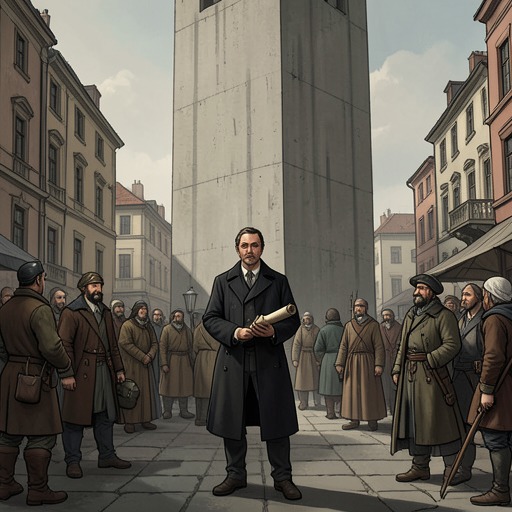
In 1534 Cromwell turns to Marsiglio of Padua’s propositions to explain to Henry VIII a theory of secular government. As Cromwell presents it, Christ came as a subject, not as an earthly ruler, and did not give the Pope or other churchmen authority to make laws or levy taxes. Priests, like other people, are subjects of the temporal ruler. The prince governs citizens’ bodies and exercises authority over civil matters, including marriage and legal legitimacy.
Cromwell’s account locates the source of kingship in a legislative body acting on behalf of citizens: the king derives his kingship from the people’s will expressed in Parliament. The argument is carefully bounded. When Henry seems to hear in it a possible justification for rebellion, Cromwell reassures him that Marsiglio does not legitimize rebels against a lawful monarch. The wise prince, he says, need not always be popular. The commonwealth here supplies an account of political authority grounded in the people, while also preserving the king’s position within a lawful order.
This model also reallocates the church’s material power. Grants of land, offices, promotions, and monopolies, Cromwell argues, belong to secular government rather than to churchmen. Priests and bishops should be maintained by the legislative body; the church’s remaining wealth may then be used for the public good. Henry immediately raises the possibility of breaking shrines. Cromwell had been guiding him toward a legal process of dispossession and repossession, but the king jumps to the physical seizure of religious wealth. Their exchange marks a consequential gap between a case for public authority and the force through which that authority might act.
Utopia as warning
The novel gives the ideal a darker counter-image through the reported events in Münster. Thomas More invokes the city to challenge the thought that an ideal commonwealth can be made simply by overturning existing institutions. As described in the conversation, Anabaptists have displaced the council, proclaimed the end times, and imposed rebaptism. Dissenters are driven out, while the city is besieged by its prince-bishop. A tailor called Bockelson has crowned himself King of Jerusalem, and reports of polygamy, coercion, and the seizure of property turn the language of common ownership into an account of domination.
The destruction of records sharpens More’s warning. The insurgents are said to have taken the houses of the rich, burned their letters, damaged their pictures, and destroyed the documents identifying ownership, so that the former order cannot return. The city’s upheaval does not produce a convincing common good: it erases the means by which property and memory can be traced, while a new ruler claims power in the name of a transformed society. More calls the situation Utopia with bitter irony. His concern is not that every reform is equivalent to rebellion, but that a vision of perfect order can become a justification for violence and arbitrary rule.
Cromwell’s response refuses More’s attempt to make Münster the inevitable destination of religious change. He predicts that someone inside the city will surrender it, while More imagines one heretical force suppressing another. Their disagreement keeps the concept unresolved: the existing order can be unjust, yet its violent overthrow may establish a different tyranny. Utopia functions less as a promised destination than as a pressure on political argument, exposing the danger both of defending every inherited institution and of treating destruction itself as liberation.
The imagined commonwealth and its limits
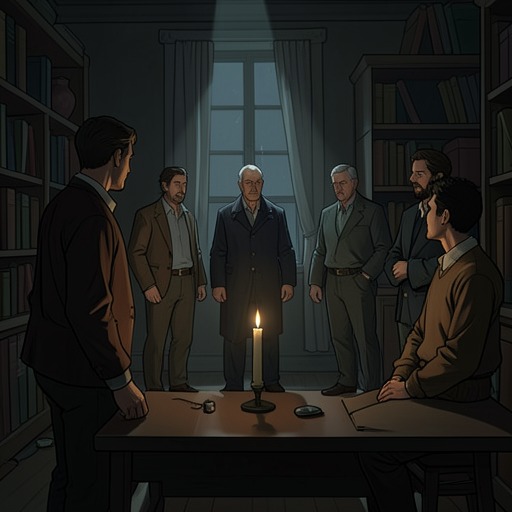
The term returns as an intimate literary reference when Cromwell, speaking with Thomas More, recalls the garden at the beginning of More’s Utopia. The allusion lends the political debate a human setting: men talking in a garden while the question of their common world is being settled elsewhere, through law and coercion. Yet the relationship between the two men prevents the reference from becoming an abstract celebration. More refuses the oath demanded of him; Cromwell continues to press him, even while trying to imagine a way he might return to his family. Their encounter makes clear that a theory of the common good cannot evade the conscience of the individual asked to obey.
During illness, Cromwell’s mind turns from ledgers to a transformed landscape. The venison being prepared for the kitchen becomes living deer again; songbirds return to branches, and honey returns to the bee and its hive. The reversal suspends the usual passage from living creature to household provision. It offers an image of restoration rather than a practical political program, and the novel presents it within fever and memory, not as a plan that Cromwell can enact.
That vision opens into an imagined city. Cromwell wonders whether this might be Utopia, then recalls Amaurotum, the City of Dreams, at the centre of the island. The place is associated with the memory machine and with the survival of knowledge even if books are burned: its spirit-made keys promise access to what remains of the past and to forms of life yet to come. The allusion joins commonwealth to memory and possibility, but leaves its realization uncertain. The novel’s Utopia is at once an argument about self-government, a warning about revolutionary certainty, and a fragile imaginative space in which the present world can be seen otherwise.